

Most of the CEOs who call me are not broke on paper. Their accountant shows a profit. Sales are steady, and sometimes they are up. And on Thursday night they are trying to figure out how to make Friday’s payroll without pulling money from somewhere it should never come from.
That is what a business in trouble usually looks like from the inside. It rarely falls apart overnight. The trouble builds quietly in the bank account, the credit line and the stack of notices on the desk, while the profit and loss statement tells everyone things are fine.
I have spent over thirty years sitting across the table from owners in this exact spot. Here is what I see, and what I tell them to do first.
How a Profitable Business Ends Up in Trouble

Profit on paper, short on cash every week.
A profit and loss statement records what you earned. Your bank account records what you collected. When those two numbers drift apart, the company starts living on borrowed time.
It usually starts with a good year or two. The owner hires ahead, leases more space, adds trucks and equipment, and sometimes upgrades the house and the car. Then sales settle back to normal and the overhead stays. I wrote about this pattern in Avoid Common Business Mistakes, and I still see it every month.
Now the company is profitable on paper and short on cash every week. So the owner borrows to cover the gap. Then borrows again. The debt grows quietly, the interest eats the margin, and by the time anyone calls it a crisis, half the options are gone.
Seven Signs Your Business Is in Trouble Even When the Numbers Look Good
- You are paying this month’s bills with next month’s money. Every deposit is spoken for before it clears.
- The line of credit has become your operating account. A credit line used to cover losses is one of the most common places a company’s origin of failure begins.
- Receivables are growing faster than sales. You are doing the work and financing your customers for free.
- Payroll taxes or sales taxes are falling behind. These are company killers. Government agencies are the least patient creditors you will ever have.
- You are selling more and keeping less. Higher volume with shrinking margins speeds up the problem.
- Late notices are stacking up on your desk. Setting them aside and hoping they go away has never worked for a single client of mine.
- You stopped taking a paycheck, and nobody else knows. The owner is usually the first person the company stops paying.
If three or more of these sound familiar, your business is in trouble. That is a diagnosis you can still act on. For a broader list of early warning signs, read Quick Turnaround of a Business in Trouble.
The Sentence That Keeps a Business in Trouble
The most expensive words I hear from CEOs are “this is the way it should be,” “this is the way it could be,” and “this is the way it is supposed to be.”
None of those sentences pay a bill. The only sentence that helps is this one: this is the way it is, period. Once an owner says that out loud, we can go to work. I explain why in What Triggers a CEO to Fail?
What I Look at First
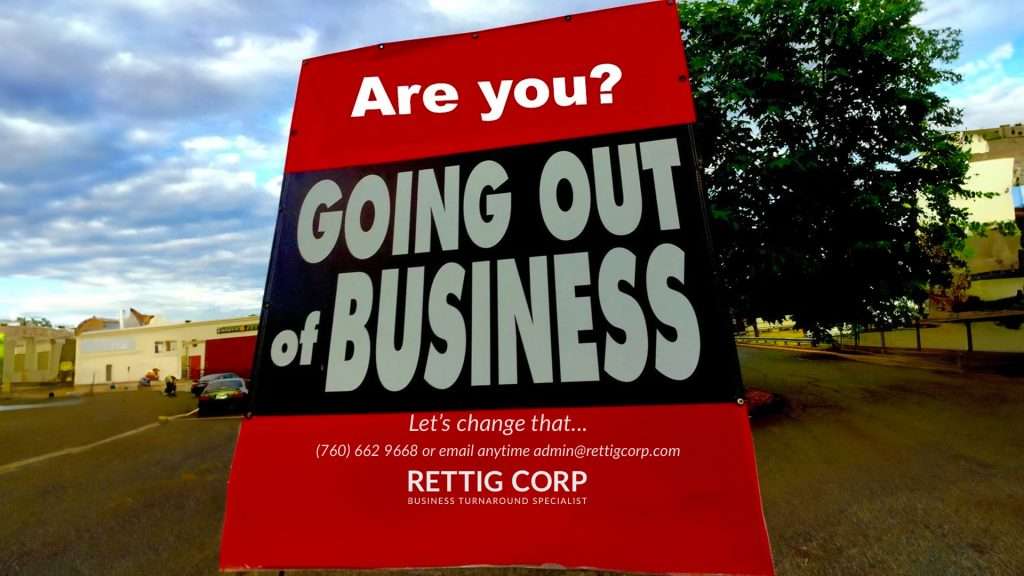
Waiting for the next big sale is how good companies run out of options.
When a business in trouble comes to me, cash flow is the order of business from minute one. Before we talk about strategy, Chapter 11 or growth, I want three numbers on a single page:
- How much money is in the bank today
- How much is owed by the first of the month
- How much is needed to make the bills
We call it the Critical Profit report. On that same page we mark the company killers, the obligations that must be paid or the company is in jeopardy. Payroll, payroll taxes, insurance and the vendors who keep the doors open go to the top.
From there the work gets practical:
- Stop borrowing to cover a loss. More money on top of a broken structure buys a few weeks and makes the hole deeper.
- Cut back to positive cash flow. Asking everyone to take a pay cut usually costs you your best people. Removing payroll and overhead the company cannot carry is harder and works better.
- Get back to produce, deliver and collect. Every job should be priced to make money, finished on time and collected on schedule.
- Tell the bank and vendors the truth. Promising a lender you will be caught up in 30 days when you know you won’t destroys the trust you will need later.
Be Careful Who You Call
The moment your company is in trouble, your inbox and your feed fill up with miracle loans, instant turnarounds and one-stop bankruptcy filings. They prey on owners who are scared and moving fast. I call these people reorganization bamboozlers, and I wrote about them in The Reorganization Trap: Don’t Be Fooled.
A real advisor will look at your actual numbers before recommending anything. Sometimes Chapter 11 is the right tool. Many times you do not need it at all. You can see how I approach both paths on my Business Turnaround Services page.
A Second Chance Has to Be Protected
I once met with a family whose company was bringing in $7,000 a month against $25,000 a month in expenses. Most people in my field would have walked away. They did everything on my list, every day, and the company stabilized at $70,000 a month. I tell that story in Second Chances in Business and Life.
What saved them was discipline after the crisis passed. They watched cash daily and never went back to the habits that got them in trouble. When family members disagree about what needs to change, that discipline gets tested fast. I cover that in Family Business Conflict in Chapter 11.
If Your Business Is in Trouble, Start Here
Do not wait for the next big sale, the next loan or the next busy season to fix it. Waiting is how good companies run out of options.
Call me at (760) 662-9668 or send me a message. The first conversation is free. We will look at where your company stands today, what can be fixed and what the road back looks like. You can also learn more about how I work as a corporate turnaround specialist.
Patrick Rettig
CEO, The Rettig Corporation
Frequently Asked Questions
How do I know if my business is in trouble?
Look at cash before profit. If you are paying current bills with future deposits, relying on a credit line to cover operating costs, falling behind on payroll or sales taxes, or skipping your own paycheck, your business is in trouble even if the P&L shows a profit.
Can a profitable business go bankrupt?
Yes. Profit is recorded when you earn it. Cash arrives when you collect it. A company with slow receivables, heavy debt payments or overhead built for a better year can show a profit and still run out of money to pay its bills.
Should I file Chapter 11 if my business is in trouble?
Not automatically. Chapter 11 is one tool. Many companies can avoid bankruptcy by restoring cash flow, cutting overhead the business cannot carry and renegotiating with creditors. The right answer depends on your actual numbers, which is why the first step is an honest review of where the company stands.
